Narrow Linewidth Tunable Laser Source for Opto-Electronic Packaging
For opto-electronic packaging QC, a narrow linewidth tunable laser that serves as a known-good reference for packaged laser diodes, VCSELs…

Key Highlights
Automotive production depends on knowing exactly which part went into which vehicle. Engine blocks, cylinder heads, gearbox housings, brake callipers and chassis members all carry an identity: a serial number, a batch code, a Data Matrix code or a VIN, read again and again from casting to final assembly and into service.
Many of these marks are applied early and must still be readable after machining, shot blasting, heat treatment, painting or e-coating. Labels peel, ink burns off and dot-peen marks can fill with paint. A mark engraved into the metal stays part of the component for the whole of its life.
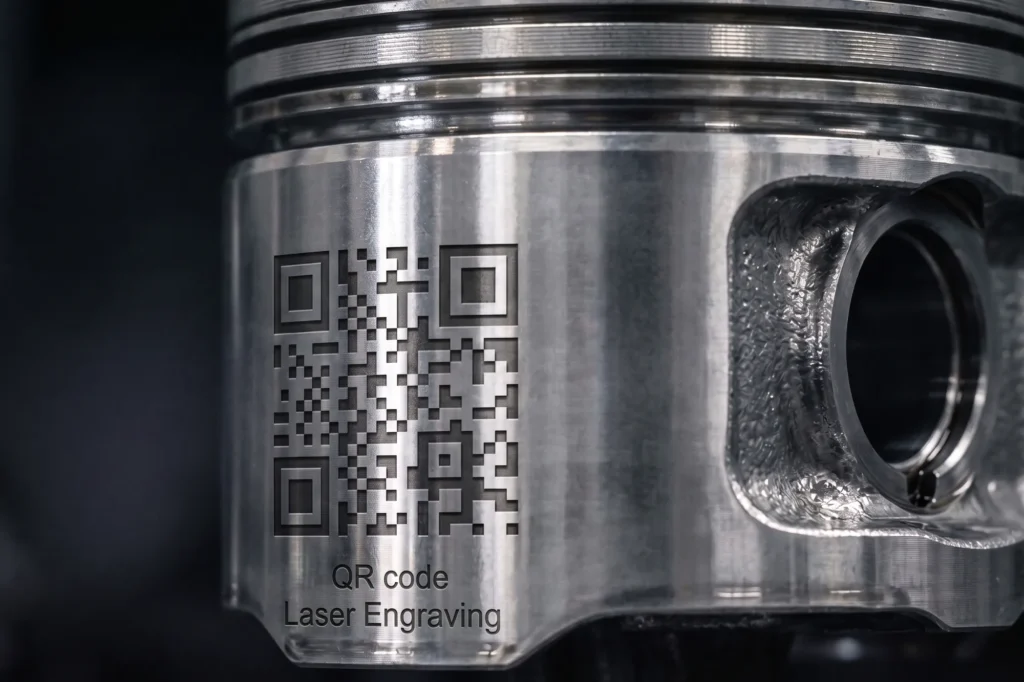
Laser engraving uses a focused fibre laser beam, steered by a galvanometer scanner, to remove material and cut text, logos and codes into the surface. Because nothing touches the part, there is no tool wear and no force on thin or finished sections, and the mark comes straight from the production database.
In automotive work the same process covers three quite different jobs: direct part marking of components on the line, engraving and texturing of moulds and stamping dies in the tool room, and in-place marking of large parts such as body panels and engine blocks.
A shallow surface mark may look sharp on the bench and still disappear after the next process. Depth is set by what the part will go through:
Each machine is designed to fit how automotive parts actually move through a plant.
The automatic metal laser engraving machine uses two pallets. Parts are loaded on one, by hand or by robot, while the laser engraves the part on the other, so the laser is rarely idle.
Machine vision finds each part’s datum and corrects for variation in position, so a code always lands in the same place on a casting, even when fixtures are not perfect.
Interfaces for conveyor feed, robotic loading, barcode job selection and ERP or MES data let each part receive its own serial or code from the plant system without manual entry.
A 6-axis or 7-axis industrial robot carries the scan head to the part. Body panels at the body-in-white stage, engine blocks and large tool blocks can be marked where they sit.
For direct part marking of engine blocks, gearbox housings and safety-critical parts, the Automatic Metal Laser Engraving Machine combines a pallet changer, vision alignment and line interfaces with a 20 W to 100 W+ fibre laser. In the tool room, the Deep Laser Engraving Machine engraves injection mould cavities and textures stamping die faces to depths of several millimetres. For body panels, chassis members and other parts too large to load into a cabinet, the Robotic Laser Engraving Machine brings the laser to the part. Fumes from every station are captured at source by the BOFA AD Oracle SA iQ, a stand-alone extractor with HEPA and activated carbon filtration and iQ filter monitoring.
United Spectrum Instruments (USI), Chennai, is the authorised distributor in India for ACSYS Lasertechnik, the German maker of these laser engraving machines, and for Donaldson BOFA fume extraction. USI supplies complete laser engraving setups for automotive plants, component suppliers and tool rooms.
USI helps match the machine, laser source and part handling to your components and line, and provides installation and after-sales support across India.
Download the brochure from this page, use the Enquire Now button, write to sales@unitedspectrum.in, or call +91 93631 83748 / +91 97899 04948. Please mention:
Laser engraving cuts serial numbers, Data Matrix codes and VINs into the metal of automotive parts, so the mark stays readable after machining, shot blasting, painting and heat. It is non-contact, so there is no tool wear or force on the part, and each code can come straight from the plant’s ERP or MES system. That gives a reliable link between every component and the vehicle it goes into.
Depth depends on what the part goes through after marking. A code engraved before shot blasting, painting or e-coating needs enough depth to stay readable afterwards, while marks on heat-exposed parts must survive high temperatures. In tool rooms, deep engraving in hardened mould and die steel ranges from hundreds of micrometres to several millimetres. A trial on your own parts is the best way to confirm it.
Yes. The Robotic Laser Engraving Machine mounts the scan head on a 6-axis or 7-axis industrial robot, so the laser moves to the part instead of the part moving into a cabinet. It is used for VIN and compliance marks on body panels and chassis members at the body-in-white stage, and for marking engine blocks, cylinder heads, gearbox housings and large tool blocks.
United Spectrum Instruments (USI), Chennai, is the authorised distributor in India for ACSYS Lasertechnik of Germany and for Donaldson BOFA. USI supplies automatic, deep and robotic laser engraving machines with matching fume extraction to automotive plants, component suppliers and tool rooms, as a complete setup from one supplier with pre-sales guidance, installation and after-sales support.
Download the brochure from this page or click Enquire Now. You can also email sales@unitedspectrum.in or call +91 93631 83748 / +91 97899 04948. For an accurate quote, mention the parts and materials, the type of mark and the processes it must survive, your cycle time or daily volume, how parts are fed and whether fume extraction is needed.


