Narrow Linewidth Tunable Laser Source for Opto-Electronic Packaging
For opto-electronic packaging QC, a narrow linewidth tunable laser that serves as a known-good reference for packaged laser diodes, VCSELs…

Key Highlights
Automotive parts and the tools that make them wear in small, predictable places: the lobe of a cam, the bearing seat on a shaft, the cutting edge of a stamping die, the parting line of an injection mould. Most of the part is still good when that small area fails, yet the usual answer is to scrap it or send it away for a long repair.
Making the whole part from a harder or more corrosion-resistant alloy is costly and often impractical. Adding a thin, dense layer of that alloy only where the wear happens keeps the base material and puts the expensive material exactly where it works hardest.
Laser cladding melts a metal powder into a shallow melt pool created by a laser beam on the part surface. The powder fuses with a thin layer of the base metal and solidifies into a dense coating with a metallurgical bond, not a sprayed layer that can flake away.
Because the laser heats only a small zone, the rest of the part stays cool and distortion is low. On automotive work, laser cladding is used to add wear-resistant layers to new parts, to rebuild worn shafts and cams to size, and to restore the working faces of dies and moulds so they can go back into production.
A good clad layer is hard, dense and well bonded, with as little mixing of base metal into the coating as possible. Three factors control this:
The same equipment serves die and mould repair shops, component remanufacturers and production lines adding wear layers to new parts.
The 5-axis laser cladding machine combines laser cladding, laser hardening and laser welding in one cell, with CNC software that switches process parameters for each job. Gears, shafts and cams can be clad and then hardened without moving to another machine.
Laser hardening heats only the surface track and lets the cold core of the part quench it, so no oil or water quench is needed and distortion stays low.
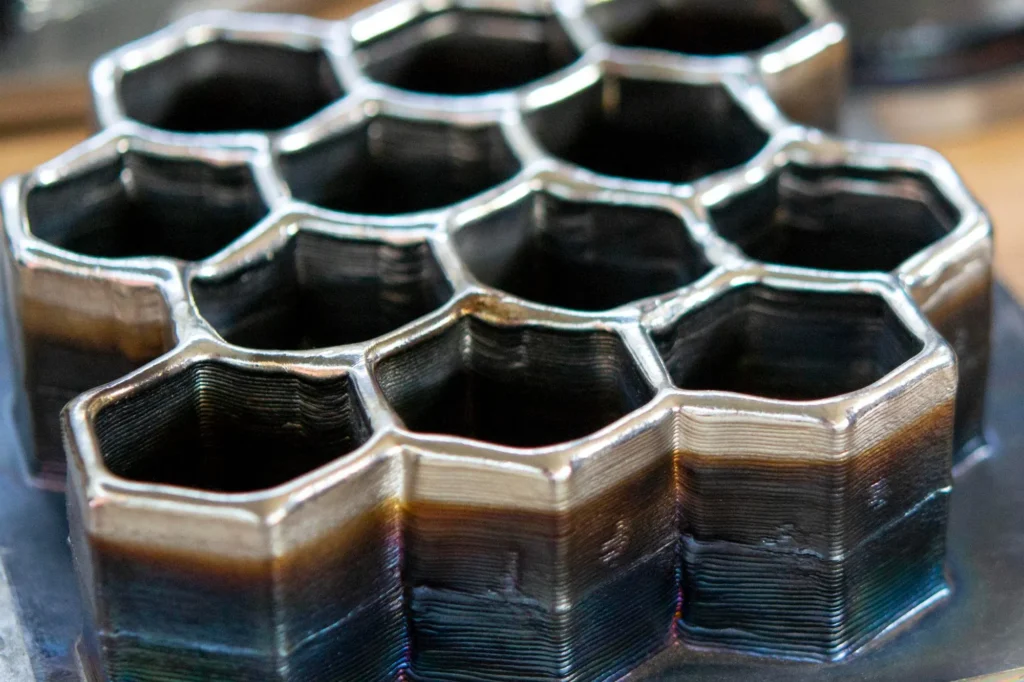
Powder deposition builds material at 0.1 to 0.5 mm per pass, with positioning accuracy better than ±0.01 mm, to restore worn die edges and reshape mould cavities.
Pulsed fibre laser cleaning removes rust, scale and old coatings without chemicals or blasting media, leaving a clean surface for cladding or welding.
Work usually starts with the Industrial Laser Cleaning Machine, a pulsed fibre laser of up to 2000 W that strips rust, scale and coatings so the surface is clean before it is clad. The 5 Axis Laser Cladding, Hardening and Welding Machine then applies the wear layer and hardens the surface in one setup. Where whole edges or cavity sections have to be rebuilt, the Powder Deposition Laser Welding Machine adds material layer by layer over a workspace of up to 1500 × 600 × 700 mm. For small cracks, worn corners and fine detail on moulds and dies, the Laser Welding Machine for Mould Repair welds at 100 to 300 W with a weld depth of 0.1 to 2 mm.
United Spectrum Instruments (USI), Chennai, supplies laser cladding and powder deposition systems in India, together with Sigma Laser mould repair welding machines and Netalux laser cleaning machines, so a complete laser cladding cell for automotive work comes from one supplier.
USI helps choose the process, laser source and powder for your parts, and provides installation, training and after-sales support, including procurement support for government buyers through GeM.
Download the brochure from this page, use the Enquire Now button, write to sales@unitedspectrum.in, or call +91 93631 83748 / +91 97899 04948. Please mention:
Automotive parts and tools usually wear in one small area, such as a cam lobe, a bearing seat or a die edge. Laser cladding adds a thin, dense layer of a wear- or corrosion-resistant alloy only where it is needed, with a metallurgical bond to the base metal. Worn parts can be rebuilt to size and dies and moulds restored instead of being scrapped.
A focused laser heats only a small zone, so finished or hardened automotive parts are not distorted or softened around the repair. Low dilution means only a thin layer of base metal mixes into the clad, so the coating keeps the hardness and corrosion resistance of the powder alloy. Multi-axis motion keeps layer thickness even on curved surfaces such as shafts and cams.
Yes. The 5-axis laser cladding, hardening and welding machine combines all three processes in one cell, with CNC software that switches process parameters for each job. Gears, shafts and cams can be clad and then surface-hardened without moving to another machine, and laser hardening needs no oil or water quench, so distortion stays low.
United Spectrum Instruments (USI), Chennai, supplies laser cladding and powder deposition systems in India, together with Sigma Laser mould repair welding machines and Netalux laser cleaning machines. Automotive plants, tool rooms and remanufacturers get a complete laser cladding cell from one supplier, with help choosing the process and powder, installation, training and after-sales support.
Download the brochure from this page or click Enquire Now. You can also email sales@unitedspectrum.in or call +91 93631 83748 / +91 97899 04948. For an accurate quote for automotive work, mention the parts or tools to be clad with their material and size, the wear problem, whether the job is new-part coating or repair and the expected volume.


