Narrow Linewidth Tunable Laser Source for Opto-Electronic Packaging
For opto-electronic packaging QC, a narrow linewidth tunable laser that serves as a known-good reference for packaged laser diodes, VCSELs…

Key Highlights
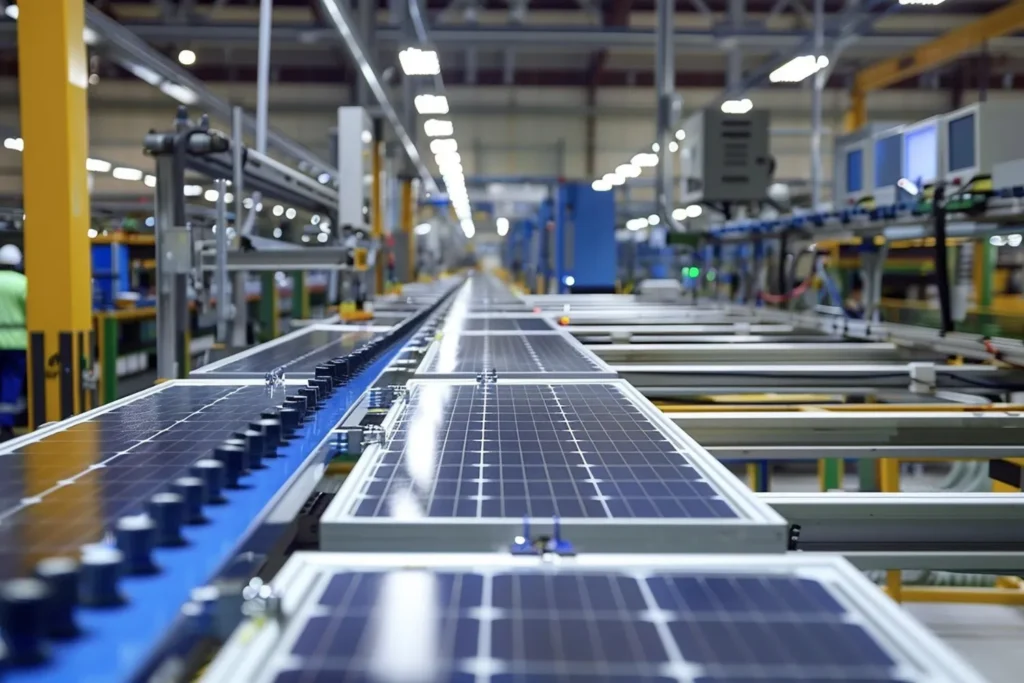
Solar panel manufacturing runs as a long sequence of steps. Cells are screen printed with conductive paste and dried, thin-film and cell layers are scribed or patterned by laser, cells are soldered into strings, laid up with glass and encapsulant, laminated, framed and fitted with junction boxes.
Several of these steps release fumes or fine particles: solvent vapours from printing pastes, debris and plume from laser scribing, flux smoke from ribbon and junction box soldering, and dust from trimming and framing. Particles that land on a cell before lamination stay inside the finished module, and fumes reach operators along the line. In solar panel manufacturing, extraction has to follow the product from the printer to the framing station.
A dust fume extractor captures dust and fumes at the printer, laser or workstation, passes them through filter stages and returns the cleaned air to the hall. Fixed units serve machines that stay in one place, such as printers and scribing lasers, while a mobile unit can be wheeled to soldering, rework and finishing stations along a long module line.
The setup on this page pairs Donaldson BOFA extractors with an ultrashort-pulse laser ablation machine for scribing.
A solar line produces three main types of emission, and each needs a different filter stage:
Each product covers a different stage of a solar panel line.
The PrintPRO 1000 iQ gives 850 m³/hr at 100 mbar from a dual blower, below 60 dBA, with HEPA and activated carbon filters. Its iQ platform shows live diagnostics and filter life for each stage, with alerts before saturation.
The Picosecond Laser Micro-Ablation Machine uses femtosecond or picosecond pulses from below 300 fs to 10 ps, at 1030, 1064 or 515 nm and 10 to 100 W. It performs P1, P2 and P3 scribing and selective ablation of transparent conductive layers, with ±5 µm position accuracy.
The AD Base 2 Oracle is a laser machine base and fume extractor in one, with pre-filter, HEPA and chemical filter stages. Its iQ system gives filter alerts and USB data tracking, and one unit can serve a dual-head laser or two laser stations close together.
The Mobile FumeKART runs on castor wheels with an adjustable extraction arm, giving 380 m³/hr through HEPA and carbon filters, with a filter condition indicator. It can be moved between stringing, junction box, rework and finishing stations.
Screen printing and drying of cells are connected to the PrintPRO 1000 iQ. Thin-film and cell layers are scribed and patterned on the Picosecond Laser Micro-Ablation Machine, which stands on an AD Base 2 Oracle so the laser and its extraction share one footprint. Along the module line, the Mobile FumeKART is a dust fume extractor that moves to wherever soldering, rework or finishing is happening. Genuine BOFA replacement filters for every unit are supplied from India.
United Spectrum Instruments (USI), Chennai, is the authorised distributor of Donaldson BOFA in India and supplies dust fume extractor systems, print and laser fume extractors, laser micro machining systems and genuine replacement filters for solar panel manufacturing.
USI helps match each printer, laser and workstation to the right unit and filter set, and provides installation, training and after-sales support across India.
Download the brochure from this page, use the Enquire Now button, write to sales@unitedspectrum.in, or call +91 93631 83748 / +91 97899 04948. Please mention:
A solar line prints, dries, scribes, solders, laminates and frames in one long sequence. Paste vapours, laser debris, flux smoke and framing dust are released along the way. Particles that land on a cell before lamination stay inside the finished module, and fumes reach operators nearby, so capturing them at each stage keeps both the product and the air cleaner.
Yes. Printing and drying conductive pastes releases solvent vapours and VOCs over every shift. The BOFA PrintPRO 1000 iQ gives 850 m³/hr at 100 mbar through HEPA and activated carbon filters, runs below 60 dBA and uses its iQ platform to show filter life for each stage and to alert before the filters saturate.
The Picosecond Laser Micro-Ablation Machine performs P1, P2 and P3 scribing and selective ablation of transparent conductive layers with femtosecond or picosecond pulses. The laser can stand on a BOFA AD Base 2 Oracle, a machine base and fume extractor in one, with pre-filter, HEPA and chemical stages and iQ filter alerts.
United Spectrum Instruments (USI), Chennai, is the authorised distributor of Donaldson BOFA in India. USI supplies print fume extractors, laser fume extractors, mobile extractors, laser micro machining systems and genuine filters to solar cell and module makers and PV research centres, as a complete setup from one supplier with installation, training and after-sales support.
Download the brochure from this page or click Enquire Now. You can also email <a href=”mailto:sales@unitedspectrum.in”>sales@unitedspectrum.in</a> or call <a href=”tel:+91 93631 83748″>+91 93631 83748</a> / <a href=”tel:+91 97899 04948″>+91 97899 04948</a>. For an accurate quote, mention the stages to be covered, your cell or thin-film technology, the number of printers, lasers and workstations, the length of the module line and your shift pattern.


