
High Resolution Optical Spectrum Analyser in India
A high resolution optical spectrum analyser (HR-OSA) shows the optical spectrum of a signal in far finer detail than a conventional grating-based OSA. That detail...
High Resolution Optical Spectrum Analyser in India

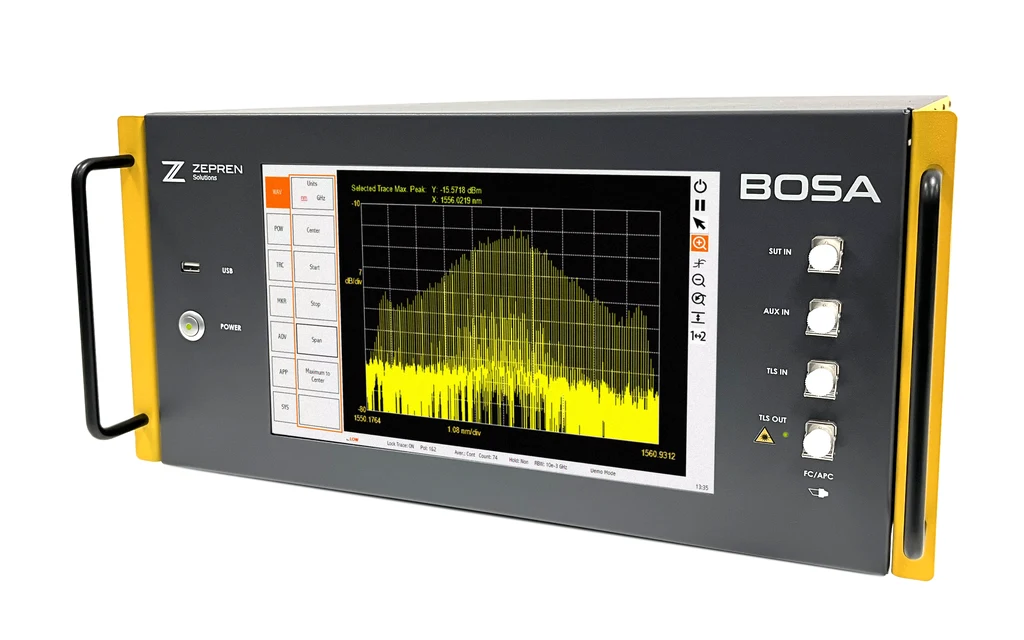
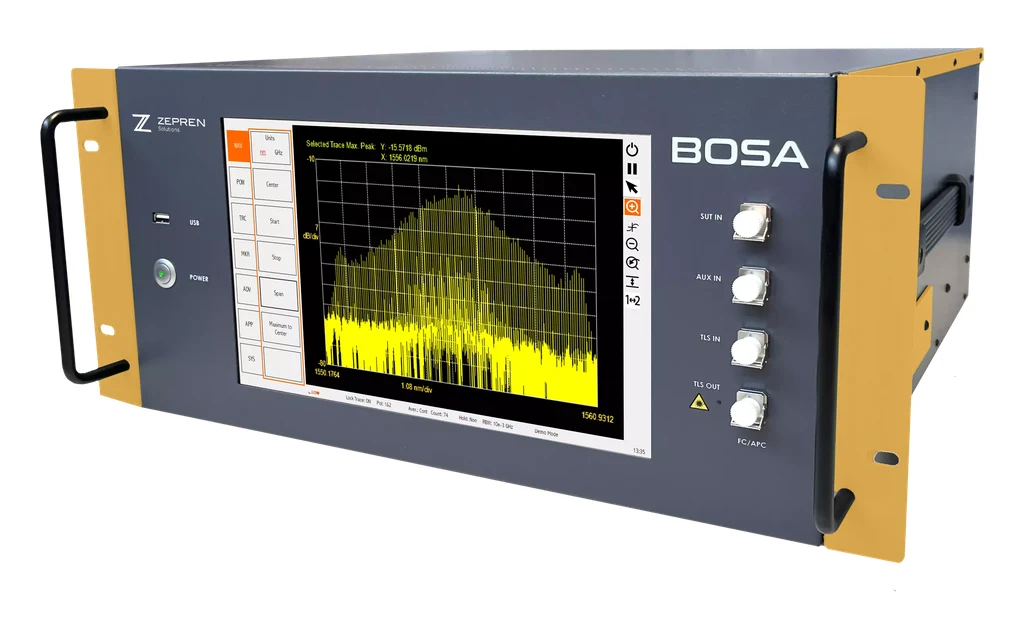
Ultra-High Resolution 0.08 pm (10 MHz) Optical Spectrum Analyser for Frequency Combs, 800G/1.6T and Chirp Analysis — BOSA by Zepren
A high resolution optical spectrum analyser (HR-OSA) shows the optical spectrum of a signal in far finer detail than a conventional grating-based OSA. That detail is what you need to see individual comb lines, closely spaced channels, modulation sidebands and laser chirp, rather than a blurred envelope.
The BOSA from Zepren Solutions, Spain, is an ultra-high resolution OSA built on a patented all-optical technology. It resolves the spectrum at 10 MHz (0.08 pm) with a purely optical narrow filter, delivers a spurious-free dynamic range above 80 dB, and measures in real time over a calibrated power range of +13 to −70 dBm. An integrated tunable laser is standard, and options add a tunable laser output, a passive component analyser, spectral polarimetry and optical phase measurement, turning one instrument into a complete spectral characterisation platform.
BOSA is available in multiple wavelength bands from below 1 µm up to the U-band, and can be remotely controlled over GPIB or Ethernet with SCPI commands from LabVIEW, Python or MATLAB.
United Spectrum Instruments is the authorised sales partner of Zepren in India, providing application guidance, quotations, demonstrations, delivery and after-sales technical support to research institutions, academic laboratories and telecom companies.
BOSA vs a Compact Optical Spectrum Analyser: Which Do You Need?
| Feature | BOSA High Resolution OSA | ID OSA Compact OSA |
|---|---|---|
| Optical resolution | 10 MHz (0.08 pm) | 312.5 MHz (2.5 pm) |
| Dynamic range | >80 dB spurious-free | >90 dB input power range across two ports |
| Wavelength coverage | Multiple bands from <1 µm to U-band (one band per unit) | C-band or L-band |
| Extra capabilities | Optional tunable laser output, component analyser, spectral polarimetry and phase measurement | Spectrum and OSNR analysis |
| Form factor | 19″ rack-mountable benchtop instrument with integrated display | Half-width 19″ 1 HE module |
| Best for | Frequency combs, pulsed lasers, 800G/1.6T signals, chirp and modulator analysis, research labs | DWDM channel monitoring, OSNR, production and rack-mounted test rigs |
Which to choose: pick BOSA when you need to resolve features in the MHz range or measure phase, chirp and polarisation in one instrument. Pick the ID OSA compact optical spectrum analyser when you need a compact, fast, calibration-free OSA for C- or L-band production and network testing. Contact United Spectrum Instruments, Chennai, for a quote or demo anywhere in India.
Understanding the High Resolution Optical Spectrum Analyser
What is a high resolution optical spectrum analyser?
An optical spectrum analyser plots optical power against wavelength. A high resolution OSA does the same with a much narrower measurement filter, so spectral features that sit only a few MHz apart are shown separately instead of merging into one peak.
Why does 10 MHz (0.08 pm) resolution matter?
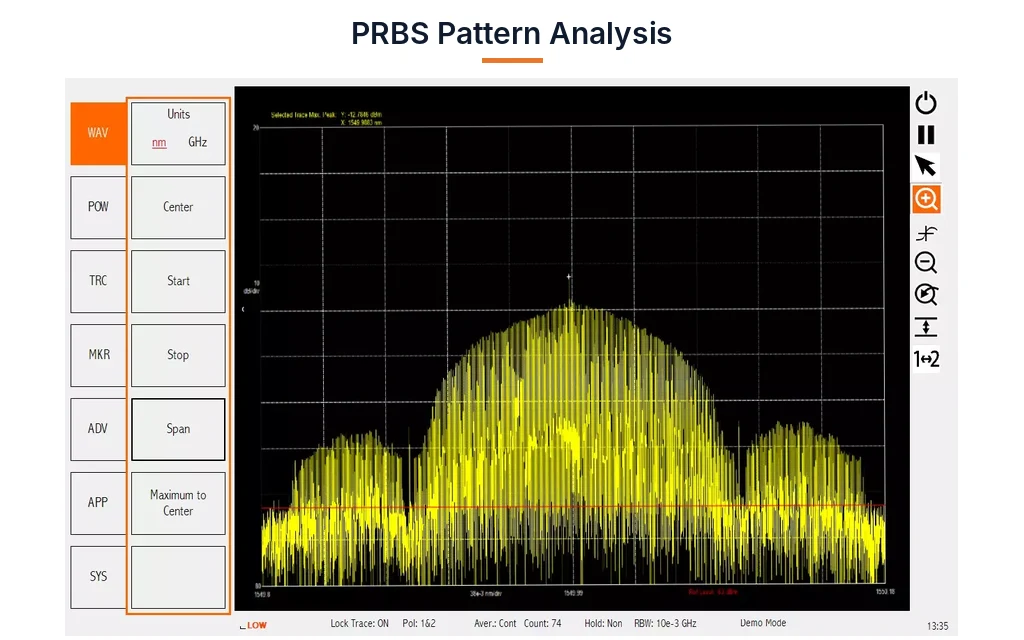
Most grating OSAs resolve around 20 pm, roughly 2.5 GHz at 1550 nm. BOSA resolves 10 MHz, about 250 times finer. At that level you can see the individual lines of a frequency comb, the sidebands of a modulated signal, the linewidth behaviour of a laser and the close-in noise around a carrier.
How does BOSA achieve this?
BOSA uses a unique, patented all-optical measurement technique with a purely optical narrow filter, scanned with an integrated tunable laser. Because the filtering is optical rather than electronic, the trace is free of the spurious artefacts that limit other high resolution methods, giving more than 80 dB of spurious-free dynamic range.
Can BOSA measure more than the power spectrum?
Yes. With the phase measurement option BOSA becomes an optical complex spectrum analyser that captures both amplitude and phase, so eye diagrams, constellations and time-resolved chirp can be calculated directly. The spectral polarimetry option adds state-of-polarisation and PDL measurement across the spectrum.
Technical Specifications
| Optical | |
| Optical resolution (FWHM) | 10 MHz (0.08 pm) |
| Calibrated power range | +13 to −70 dBm |
| Spurious-free dynamic range | >80 dB |
| Wavelength reference | Linearisation + absolute reference |
| Power accuracy | ±0.5 dB |
| Wavelength accuracy | ±0.5 pm (±1.0 pm in O-band) |
| Measurement speed | 10 nm/s |
| Option 10 – Tunable laser output | |
| Tuning speed | 10, 20, 40 or 100 nm/s |
| Output power | >1 mW |
| Option 20 – Component analyser | |
| Wavelength accuracy | ±1.0 pm (±2.0 pm in O-band) |
| Power accuracy | ±0.2 dB |
| Polarisation measurement | Two orthogonal states; PDL with Option 30 |
| Measurement time | 1 s for 100 nm or 1 s for 10 nm |
| Option 30 – Spectral polarimetry | |
| Polarisation repeatability | ±5° |
| Temperature dependence | ±0.2°/°C |
| Measurement time | 6 scans at 10 nm/s |
| Polarisation sensitivity | −40 dBm |
| Option 40 – Phase measurement | |
| Bandwidth | 80 MHz to full span |
| Pattern frequency range | 70 MHz to 2 GHz |
| Phase accuracy | ±1° |
| Measurement time | 1 s for 10 nm |
| Available wavelength bands | |
| <1 µm | 885–935 nm, 925–985 nm |
| T-band | 1005–1105 nm (T1: 1035–1065 nm, T2: 1075–1125 nm) |
| O-band | 1265–1345 nm |
| E-band | 1360–1475 nm |
| S+C+L | 1485–1610 nm |
| C+L | 1525–1610 nm |
| C-band | 1525–1565 nm |
| U-band | 1625–1745 nm |
| Interfaces | |
| Remote control | GPIB or Ethernet, SCPI commands |
| Programming | LabVIEW, Python, MATLAB |
Specifications are taken from the Zepren BOSA brochure. For full specifications for your band and options, contact United Spectrum Instruments.
Key Features and Advantages
10 MHz (0.08 pm) Purely Optical Resolution
A narrow all-optical filter resolves comb lines, sidebands and closely spaced channels that a grating OSA cannot separate.
Over 80 dB Spurious-Free Dynamic Range
Traces are free of measurement artefacts, so low-level features close to a strong carrier are real and can be trusted in both R&D and production.
Real-Time Measurement
BOSA measures continuously in real time, so you can watch a laser or transmitter respond while you tune it.
Integrated Tunable Laser, or Use Your Own
An internal tunable laser is standard. Option 10 makes it available as a test source, and Option 100 removes it so BOSA can work with a compatible benchtop tunable laser and lower the system cost.
Four Instruments in One with Options
Add a passive component analyser (IL, RL and PDL), spectral polarimetry (SOP and PDL) and optical phase measurement (chirp, eye diagram, constellation) to the same platform.
Multiple Wavelength Bands
Choose a band from below 1 µm through T, O, E, S, C, L and U to match your lasers, transceivers or research wavelength.
Powerful Analysis Software
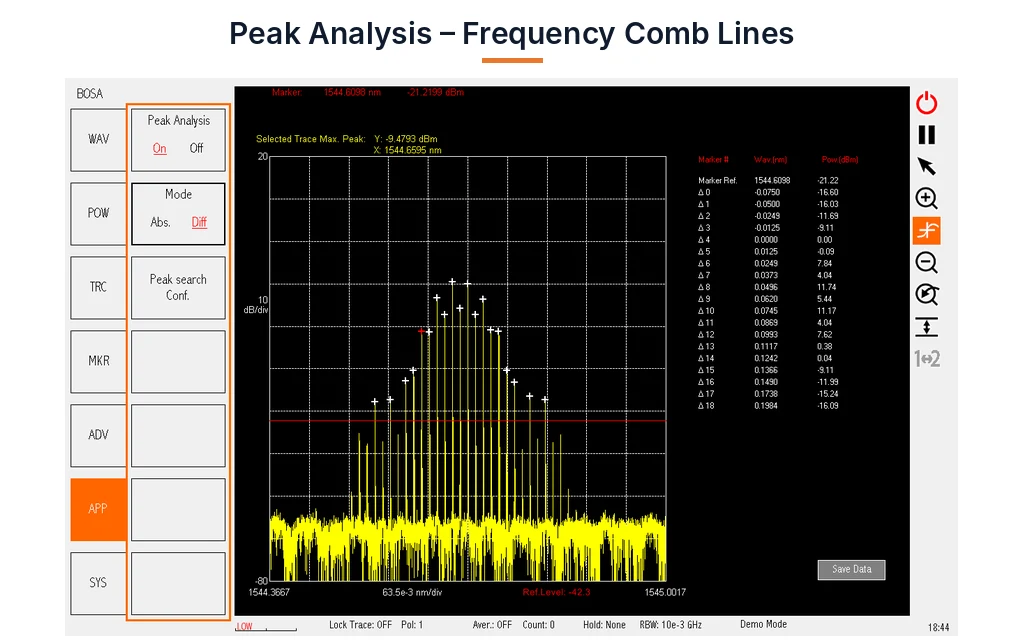
Peak analysis for combs, automatic OSNR measurement, trace locking, variable resolution to match older OSAs, power integration over a chosen span and dual-channel polarisation display.
Automation and 24/7 Operation
Full remote control over GPIB or Ethernet with SCPI commands, with LabVIEW, Python and MATLAB support, and a design robust enough to run continuously for a week.
Applications Across Industries
Frequency Comb and Pulsed Laser Characterisation
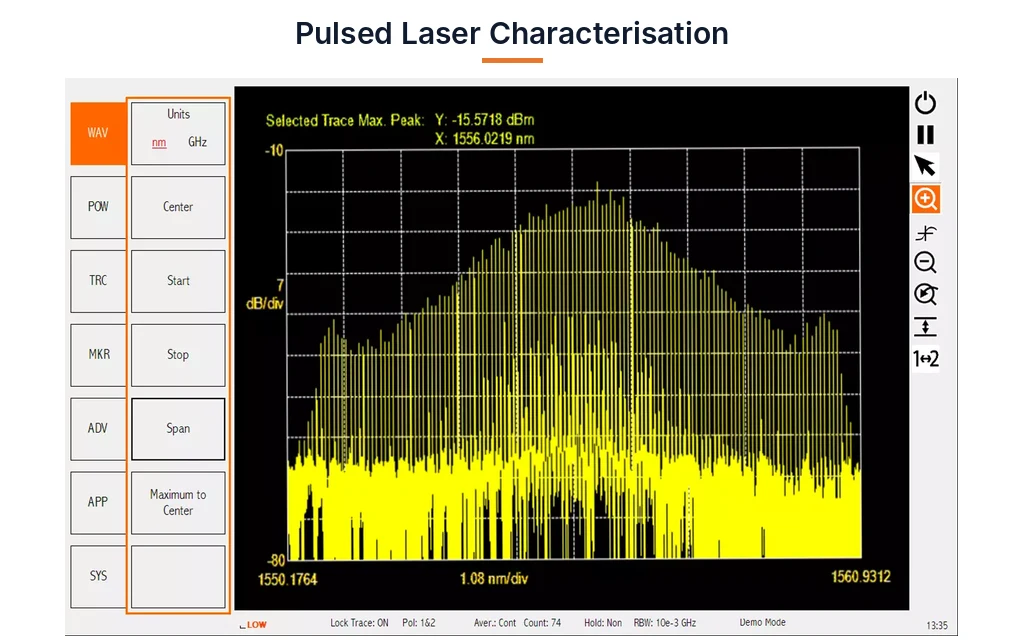
With 10 MHz resolution BOSA resolves individual comb lines and captures the spectra of femtosecond and picosecond lasers with high detail and repeatability, ideal for photonics and quantum optics research groups at IITs, IISc and national laboratories.
Single-Line Laser Characterisation (DFB, ECL, DML)
Measure the wavelength, linewidth behaviour, side modes and close-in noise of single-line optical sources such as distributed feedback (DFB) lasers, external cavity lasers (ECL) and directly modulated lasers (DML) at 10 MHz resolution.
100G to 1.6T Transceiver Testing
Telecom equipment makers and transceiver manufacturers use BOSA to inspect 100G, 400G, 800G and 1.6T signals in detail and verify their spectral quality during development and qualification.
OSNR Measurement
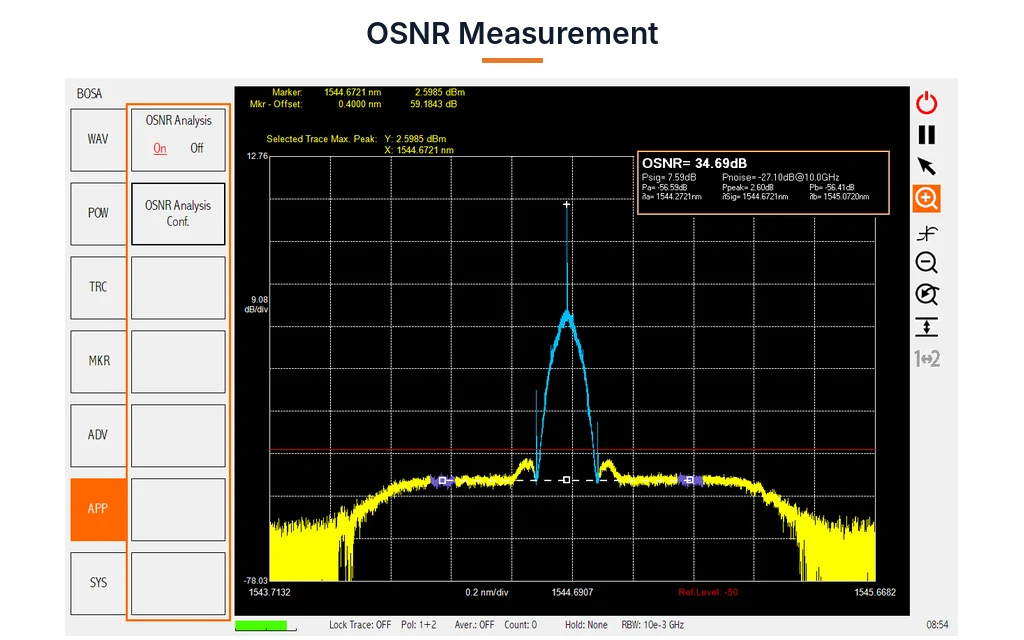
Measure optical signal-to-noise ratio (OSNR) on closely spaced and coherent channels, where a coarser grating OSA cannot separate the signal from the noise floor. Signal and noise widths are configurable and OSNR is calculated automatically.
Polarisation Balance and Alignment
With the spectral polarimetry option, check the polarisation balance of dual-polarisation transmitters, align the polarisation of different sources and track how the state of polarisation changes with wavelength.
Advanced Modulation Format Analysis
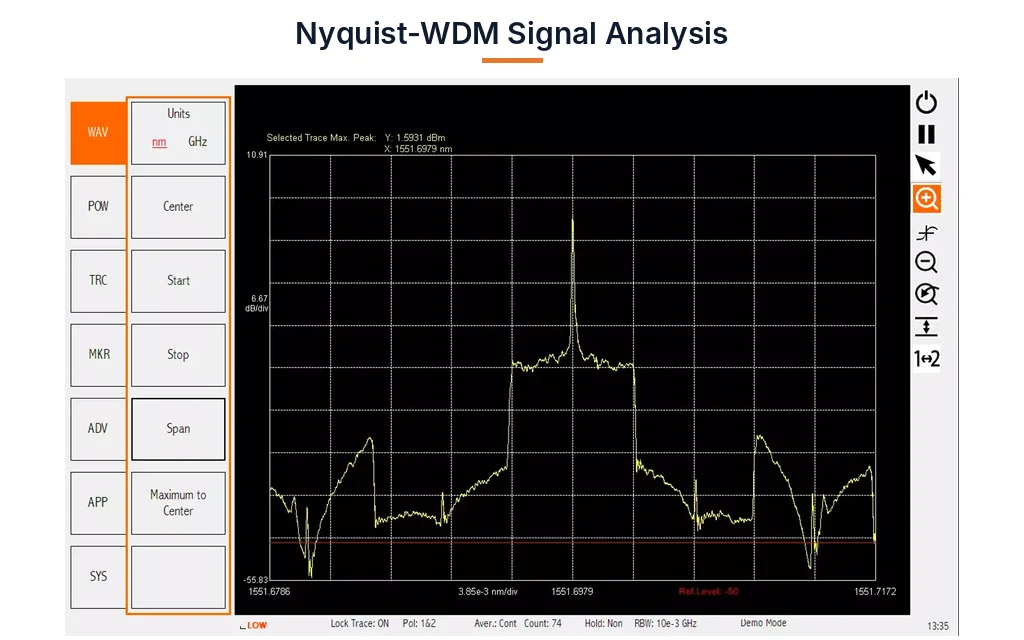
Analyse OFDM, Nyquist-WDM, PAM4, QAM and DP-QPSK signals and see the true shape of each sub-carrier and channel edge.
Chirp and Modulator Analysis
High resolution and close-in dynamic range make chirp characterisation and modulator evaluation straightforward, and the phase option measures time-resolved chirp directly.
DWDM Grid Monitoring
Characterise several channels of a DWDM grid simultaneously, including closely spaced ultra-dense channels.
Non-Linear Laser Dynamics and Linewidth Studies
Study mode behaviour, side modes and non-linear effects in semiconductor, fibre and integrated lasers.
Passive Component, PIC and FBG Testing
With the component analyser option, measure insertion loss, return loss and PDL of FBGs, resonators and photonic integrated circuits. For dedicated component test, see also the HDCA optical component analyser with OFDR.
Why Choose United Spectrum Instruments?
Authorised Zepren Sales Partner in India
United Spectrum Instruments is the authorised sales partner of Zepren Solutions in India, so you receive a genuine BOSA with manufacturer-backed calibration and support.
Help Choosing the Right Band and Options
We review your sources, wavelengths and measurement goals and recommend the band and option set (tunable laser output, component analyser, polarimetry, phase) that fits your lab.
Experience with Indian Research and Industry
We work with IITs, IISc, CSIR laboratories, defence establishments and telecom companies, and understand academic and government procurement and documentation requirements.
Delivery and Local Technical Support
We deliver anywhere in India and support installation, software, SCPI automation and troubleshooting.
A Complete Optical Test Portfolio
Alongside BOSA we supply the ID OSA compact optical spectrum analyser, tunable lasers, coherent receivers, multi-format transmitters and component analysers, so your optical test bench can come from one partner.
GET IN TOUCH WITH US
Have a Project in Mind ? Let’s Talk
FAQs
What is BOSA?
BOSA is a high resolution optical spectrum analyser from Zepren Solutions, Spain. It uses a patented all-optical technique to resolve optical spectra at 10 MHz (0.08 pm) with more than 80 dB of spurious-free dynamic range.
What resolution does BOSA offer?
BOSA has an optical resolution of 10 MHz (FWHM), equivalent to about 0.08 pm at 1550 nm, roughly 250 times finer than a typical 20 pm grating OSA.
What is the difference between BOSA and a standard optical spectrum analyser?
A standard grating OSA resolves around 20 pm and suits broad spectra. BOSA resolves 10 MHz, so it can separate comb lines, modulation sidebands and closely spaced channels, and with options it also measures phase, polarisation and passive components.
Which wavelength bands are available?
BOSA is offered in several bands: below 1 µm (885–935 nm and 925–985 nm), T-band (1005–1105 nm), O-band (1265–1345 nm), E-band (1360–1475 nm), S+C+L (1485–1610 nm), C+L (1525–1610 nm), C-band (1525–1565 nm) and U-band (1625–1745 nm). Each unit covers the band ordered.
What is the dynamic range and power range of BOSA?
BOSA offers more than 80 dB of spurious-free dynamic range and a calibrated power range of +13 to −70 dBm.
How accurate is BOSA?
Wavelength accuracy is ±0.5 pm (±1.0 pm in the O-band) and power accuracy is ±0.5 dB, using linearisation plus an absolute wavelength reference.
What options are available for BOSA?
Option 10 tunable laser output, Option 20 component analyser (IL, RL, PDL), Option 30 spectral polarimetry, Option 40 phase measurement (chirp, eye diagram, constellation) and Option 100 for use with an external tunable laser instead of the internal one.
Can BOSA measure chirp and phase?
Yes. With Option 40, BOSA becomes an optical complex spectrum analyser that measures amplitude and phase, so chirp, eye diagrams and constellations can be retrieved directly.
Is BOSA suitable for frequency comb and pulsed laser research?
Yes. Its 10 MHz resolution resolves individual comb lines and captures femtosecond and picosecond laser spectra in detail, which makes it well suited to research labs at IITs, IISc and other institutes.
Can BOSA test 100G, 400G, 800G and 1.6T transceivers?
Yes. BOSA is used for transceiver testing from 100G and 400G up to 800G and 1.6T, and for advanced modulation formats such as OFDM, Nyquist-WDM, PAM4, QAM and DP-QPSK.
Can BOSA characterise DFB, ECL and DML lasers?
Yes. Its 10 MHz resolution shows the wavelength, side modes, linewidth behaviour and close-in noise of single-line sources such as DFB lasers, external cavity lasers (ECL) and directly modulated lasers (DML).
Can BOSA measure OSNR and polarisation balance?
Yes. BOSA calculates OSNR automatically with configurable signal and noise widths, even on closely spaced channels. With the spectral polarimetry option it also measures polarisation balance and state of polarisation across the spectrum.
How is BOSA controlled and automated?
Through its built-in front-panel interface or remotely over GPIB or Ethernet using SCPI commands, with support for LabVIEW, Python and MATLAB.
Who supplies BOSA in India?
United Spectrum Instruments, Chennai, is the authorised sales partner of Zepren in India and supplies BOSA with application support, delivery and after-sales service.
How can I get a quote or datasheet for BOSA in India?
Use the Get in Touch form on this page, email sales@unitedspectrum.in, or call +91 93631 83748 or +91 97899 04948. Tell us your wavelength band, sources and measurement tasks, and we will send the datasheet and a quotation.
WHAT WE OFFER
Reliable Engineering Solutions for Modern Manufacturing

Imaging Cameras & Wavefront Sensors

Laser Sources

Dust & Fume Extractors

Industrial Laser Systems

Optical Communication Test & Measurement
Optical Sensors, IR Emitters & LEDs
