Narrow Linewidth Tunable Laser Source for Opto-Electronic Packaging
For opto-electronic packaging QC, a narrow linewidth tunable laser that serves as a known-good reference for packaged laser diodes, VCSELs…

Key Highlights
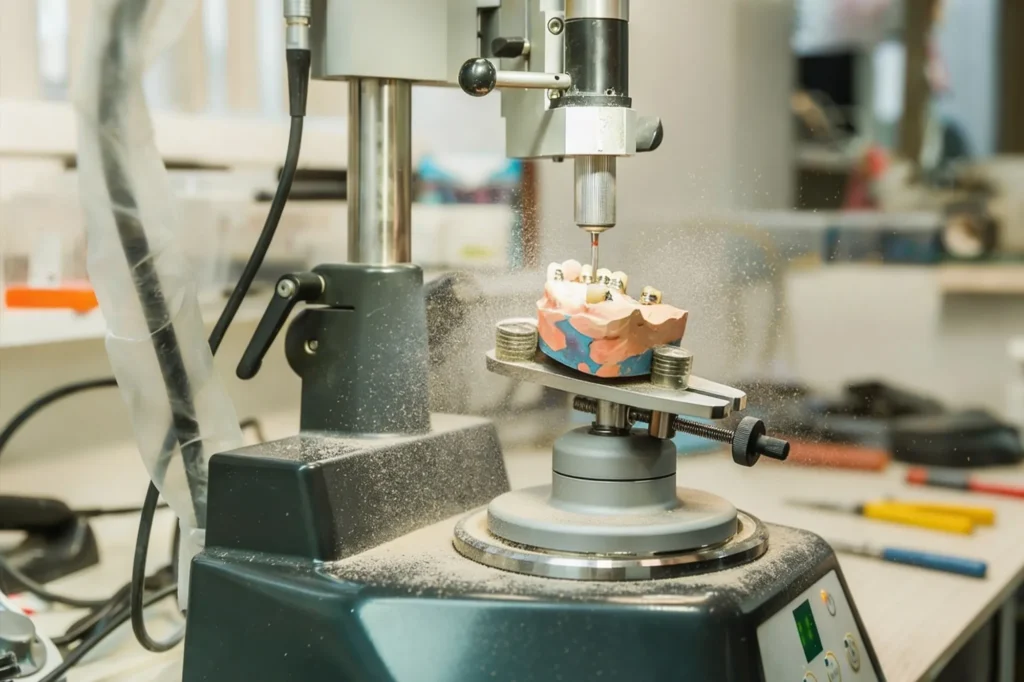
Surgical instruments, orthopaedic and dental implants, and micro devices such as stents and catheters go through many finishing steps after machining. Forceps, scissors, drills and implant tools are ground, polished and marked; implants and dental parts are trimmed and polished; and small tubes and pins are micro-machined to very fine features.
Grinding and polishing stainless steel, titanium, cobalt-chrome and polymers such as PEEK release fine dust and polishing residue, and laser processing gives off plume. In medical tools and implants manufacturing, this dust settles on finished surfaces and fixtures and reaches operators doing detailed hand work, so it is best captured at each bench before it spreads.
A dust fume extractor captures dust and fume at the grinding wheel, polishing motor or laser, passes them through HEPA and activated carbon filters and returns the cleaned air to the room. Single benches can have their own compact unit, while a finishing room with several benches can share one centralised extractor.
The setup on this page combines Donaldson BOFA extractors from the DentalPRO range with a LASIT marking laser and a GFH femtosecond laser turning machine.
How the finishing area is laid out decides the extraction:
Each product covers a different part of a medical tools and implants workshop.
The DentalPRO 400 gives 400 m³/hr at 96 mbar in a 14 kg unit with HEPA and activated carbon filters, filter condition indicators and airflow sensors that alert when filters need replacing. Its product page lists polishing and prototyping in medical device manufacturing.
The DentalPRO Universal connects to up to six workstations as a centralised system, giving 285 m³/hr at 96 mbar through HEPA and activated carbon filters, with an integrated digital display of filter condition and tool-free filter changes.
The LASIT 20W Desktop Laser Marking Machine uses a 20, 30 or 50 W fibre laser with a motorised Z-axis and a 590 × 295 mm working area. It marks stainless steel, titanium and PEEK, with FlyCAD software for serial numbers and DataMatrix codes.
The GFH GL.evo 5-Axis CNC Femtosecond Laser Turning Machine machines stents, microcatheters and cannula and needle tips, and textures implant surfaces, with 1 µm positioning accuracy and repeatability.
Single grinding and polishing benches start with the DentalPRO 400, a compact dust fume extractor beside each bench. Finishing rooms with several benches are connected to one DentalPRO Universal. Instruments and implant tools are marked on the 20W Desktop Laser Marking Machine, and stents, catheters and cannula tips are machined on the 5-Axis CNC Femtosecond Laser Turning Machine. Genuine BOFA replacement filters for every unit are supplied from India.
United Spectrum Instruments (USI), Chennai, is the authorised distributor of Donaldson BOFA, the official distributor of LASIT and the distributor of GFH GmbH in India, and supplies dust fume extractor systems, laser marking and laser micro machining systems and genuine replacement filters for medical tools and implants manufacturing.
USI helps match each bench, marker and machine to the right unit and filter set, and provides installation, training and after-sales support across India.
Download the brochure from this page, use the Enquire Now button, write to sales@unitedspectrum.in, or call +91 93631 83748 / +91 97899 04948. Please mention:
Grinding and polishing stainless steel, titanium, cobalt-chrome and PEEK release fine dust and polishing residue, and laser processing gives off plume. This settles on finished instruments, implants and fixtures and reaches operators doing detailed hand work. Capturing it at each bench keeps finishing areas cleaner, reduces cleaning of parts and protects the people working at close range.
Both work. A single bench can have a compact unit such as the BOFA DentalPRO 400, which gives 400 m³/hr through HEPA and activated carbon filters with filter alerts. A finishing room with several benches can share one DentalPRO Universal, which connects to up to six workstations and shows filter condition on a digital display.
For marking instruments and implant tools, the LASIT 20W Desktop Laser Marking Machine uses a 20 to 50 W fibre laser and marks stainless steel, titanium and PEEK with serial numbers and DataMatrix codes. For stents, microcatheters and cannula tips, the GFH 5-Axis CNC Femtosecond Laser Turning Machine works with 1 µm positioning accuracy.
United Spectrum Instruments (USI), Chennai, is the authorised distributor of Donaldson BOFA, the official distributor of LASIT and the distributor of GFH GmbH in India. USI supplies bench and centralised extractors, laser marking and micro machining systems and genuine filters to instrument, implant and medical device makers, with installation, training and after-sales support.
Download the brochure from this page or click Enquire Now. You can also email sales@unitedspectrum.in or call +91 93631 83748 /+91 97899 04948. For an accurate quote, mention the processes to be covered, the materials, the number of benches and whether they share a room, and the parts and features to be marked or machined.


