Narrow Linewidth Tunable Laser Source for Opto-Electronic Packaging
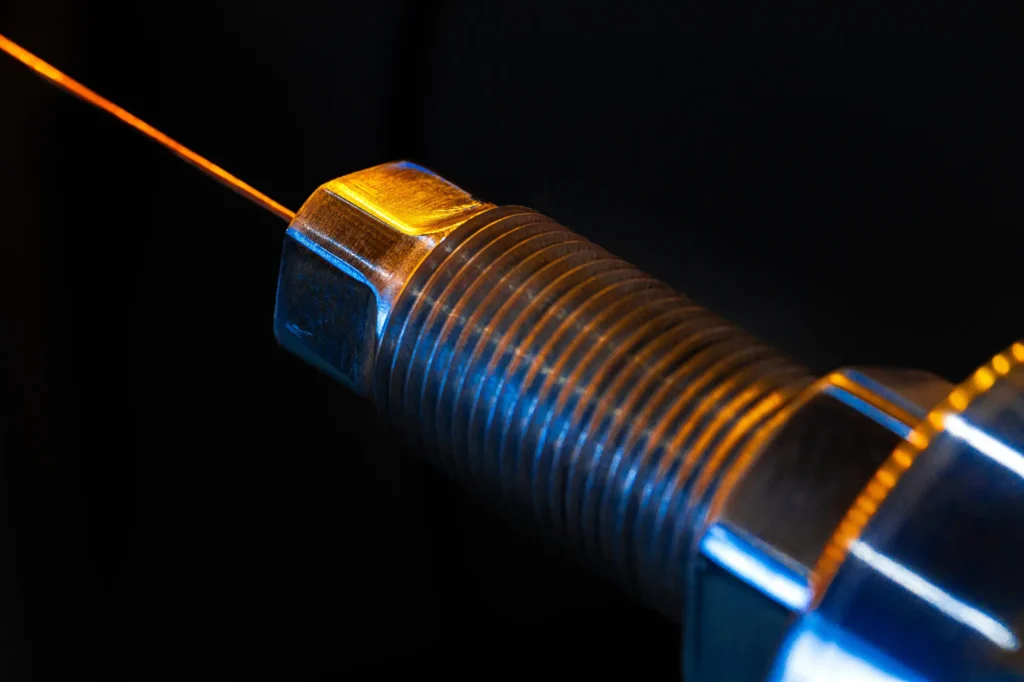
For opto-electronic packaging QC, a narrow linewidth tunable laser that serves as a known-good reference for packaged laser diodes, VCSELs…

Key Highlights
Most mechanical failures in vehicles are not caused by one overload but by millions of smaller ones. A gear tooth, a crankshaft fillet, a connecting rod or a suspension arm is loaded and unloaded every time the engine turns or the wheel hits a bump. Over time a microscopic crack starts at the surface, usually at a notch, fillet or machining mark, and grows until the part breaks.
Lighter vehicles and higher-torque electric drives make the problem harder. Engineers want thinner sections and lighter materials, while EV motor shafts and reduction gears see high, instant torque. Making the part bigger adds weight; making the surface resist crack growth keeps it light.
Laser shock peening fires very short, high-energy laser pulses at the part surface through a thin flowing layer of water. A sacrificial coating on the surface absorbs each pulse and vaporises into a plasma, and the water confines that plasma so it drives a powerful shock wave into the metal.
The shock wave plastically compresses the metal beneath the surface, leaving a layer of compressive residual stress. Because a fatigue crack needs tension to open and grow, this compressed layer holds cracks closed and slows their growth, extending the fatigue life of the part. The laser never touches the base metal, and the coating takes the heat.
Shot peening has long been used on springs and gears, but it works only near the surface. Three differences make laser shock peening suited to highly stressed automotive parts:
The system is designed to treat finished parts at the points where fatigue cracks start.
The pulsed solid-state laser delivers 0.5 to 10 J per pulse at 1064 nm, with an optional 532 nm wavelength, in pulses of 6 to 20 ns at 1 to 20 Hz.
Adjustable optics give a spot from 1 to 6 mm, and a multi-axis CNC motion system positions it to ±10–20 µm, so crankshaft fillets, gear roots and bolt holes can be targeted precisely.
Closed-loop monitoring of pulse energy, pulse stability and spot size keeps the process repeatable and gives a traceable record of treatment for each part.
The system sits in a Class 1 enclosure with a footprint of about 1000 × 900 × 1600 mm and closed-loop water cooling, and can be integrated with robots, CNC handling or fixtures.
The centre of the cell is the Compact Laser Shock Peening System, which treats fillets, gear roots and other fatigue-critical zones on finished parts. Before the sacrificial coating goes on, the Industrial Laser Cleaning Machine removes oil, oxide and residue so the coating sits on a clean surface. Where parts also need a hard wear surface, such as gear flanks, cams and shafts, the 5 Axis Laser Cladding, Hardening and Welding Machine adds laser hardening or cladding in a separate step.
United Spectrum Instruments (USI), Chennai, is the official distributor of Bright Beams Laser in India and supplies laser shock peening systems for automotive powertrain and chassis components, together with laser cleaning and laser hardening equipment for a complete surface treatment cell.
USI helps define the treatment zone and process parameters for your parts, and provides installation and after-sales support. Government and PSU buyers can procure through GeM.
Download the brochure from this page, use the Enquire Now button, write to sales@unitedspectrum.in, or call +91 93631 83748 / +91 97899 04948. Please mention:
Gears, crankshafts, connecting rods and suspension parts usually fail from fatigue: small cracks that start at fillets, roots or holes and grow under repeated loads. Laser shock peening drives a shock wave into the metal that leaves a deep layer of compressive residual stress. That layer holds cracks closed and slows their growth, so automotive parts last longer without adding weight.
Shot peening hits the surface with small balls and creates compressive stress only about 0.1–0.3 mm deep, while roughening the finish. Laser shock peening uses laser-driven shock waves to reach up to 2–4 mm, depending on material, and changes surface roughness by less than ±1 µm. Ground and finished automotive parts can therefore be treated without re-machining afterwards.
No significant change. The laser pulse hits a sacrificial coating under a thin water layer, not the base metal, so the part does not melt or heat up. Surface roughness changes by less than ±1 µm and the geometry stays the same, which is why gear flanks, bearing journals and other finished automotive surfaces can be peened after final machining.
United Spectrum Instruments (USI), Chennai, is the official distributor of Bright Beams Laser in India and supplies the Compact Laser Shock Peening System for automotive powertrain and chassis parts. USI can also supply laser cleaning and laser hardening equipment for a complete surface treatment cell, with process guidance, installation and after-sales support, and GeM procurement for government buyers.
Download the brochure from this page or click Enquire Now. You can also email sales@unitedspectrum.in or call +91 93631 83748 / +91 97899 04948. For an accurate quote, mention the parts and material, the zones where fatigue cracks start, part size and weight, any fatigue or residual stress target, your expected volume and whether robot or CNC handling is needed.


